
Revised as of May 17, 2020
Interacting with people online is much harder now than it was back in the 1990s, or even in the first decade of the 21st Century. In those first two decades of the Internet's widespread popularity, people communicated online primarily via email, online bulletin boards and instant messaging, via text they wrote themselves. Now, people communicate with photos and emojis, sometimes with no text accompanying it at all, as well as with animated gifs and images with text created by someone else, often conveying something humorous, political, or a comment on some aspect of society or modern life. As a result, how I talk and advise others about online culture now is very different than how I talked about it back at the start of the century.
Some people don't need much guidance at communications, online or face-to-face - they seem to be intuitive at connecting with people. Just as a person can be fantastic at walking into a room and engaging in a series of quick conversations that make many people in that room feel like they have made a strong connection with that person, or a natural at putting someone at ease in a face-to-face meeting like a job interview, there are people who are naturals at online communications. There are also people who attend Toastmasters or take classes on facilitation and participatory meeting techniques in order to do better job talking in groups or one-on-one. This page is for folks who are either intimidated by communicating online with others, particularly as a part of their job or volunteering, or who know they are in need of some improvement.
The internet started off as mostly text-based communications - what would be seen now as long messages. These were, and still are, sent via email or online communities, and before the new century, these were usually read by the recipient, not just glanced over - or ignored altogether. Now, more and more people are attracted to messaging that can be digested in just a few seconds. This has a significant downside: shorter attention spans, people doing other things when they should be paying attention to the conference call or video call, and easily-shared misinformation and misinterpretations of messaging.
I do think that online communications is no more difficult than face-to-face, onsite communications: even if it's rehearsed, you cannot edit whatever it is you are saying to someone in an offline, live conversation - once it's out there, it's out there. You can rehearse, but in the moment, it is what it is. You have to speak clearly, sound natural, sound sincere, and that kind of pressure, like an actor on stage, can be downright frightening for many people. Added to that is that people can misinterpret facial expressions, tone, choice of words, body language - even silence. And not everyone is good at interpreting a person's facial or voice "cues" or body language: such can and is often misinterpreted by the viewer or listener.
Here's the key in meaningful, effective online communications: it's about engagement, not just promotion. It's a conversation, not just a billboard someone drives by or a flyer someone receives in the mail. My dictionary says interactive is an adjective that means two or more people or things influencing or having an effect on each other. Yes, there can still be a leader in that conversation, but that leader also has to be a listener and an observer, and that leader has to show that what's being said in response is influencing him or her in some way. And those interactions must be perceived as authentic: sincere, from a place of genuinely wanting to hear what others want to say.
It is easy to get in the mode of seeing the reading and responding to emails, social media posts and text messaging as a long to-do list rather than human interaction. But approaching online communications this way, as just a long to-do list, or using artificial intelligence or automatic responders to interact with current and potential clients, donors and volunteers, leads to emotionally empty communications - messages that your audience won't feel any emotional connection to and, therefore, they won't feel any particular desire to donate, volunteer or otherwise support you. Your communications staff - and that includes everyone that regularly communicates with current and potential clients, donors and volunteers online - should look at virtual communications as fundamental for your programs success at your nonprofit, NGO, school, government agency or other cause-based organization.
Also remember: Online communities, Facebook posts, Tweets,
or other social media posts are not online newsletters -
they are meeting places. To be successful in online
communications, you have to treat online discussion groups and
social media platforms as communities, as real as a
physical neighborhood or an audience at a workshop or a meeting
in real-time where everyone is in the same room.
Years ago, I wrote about the wide variety of communicators I've experienced online. Here's what I said:
All of that is still true, for the most part. Added to that now are people who will respond mostly with emoticons or animated gifs (a video clip of a well-known TV star giving a thumbs up, for instance), and people who rarely use their own words - they post quotes from others in meme form to make their point.
As is noted in Working Together Online, an excellent
publication by Maureen James and Liz Rykert (that, sadly, is
no longer available), "Never make assumptions about what you
are reading." (but note: that's true in face-to-face, entirely
verbal situations as well). You cannot assume someone is
unintelligent or not worth listening to because of a text
message full of spelling errors, or that someone is angry
because of an abrupt reply via email. One person who
involves volunteers online said to me, "A few times when I
'etalked' with people for years as if they were undergrads,
then found out they were department heads!!!" The same has
been true for me, only in reverse: A few times I have
corresponded with an online
volunteer for several weeks as if that person was a
working professional, because of the tone of the person's
e-mails and the quality of work. Later, I've realized, upon
reviewing the original volunteer application, that the person
is actually 14 or 15 years old. Think of the times you have
seen someone who you would characterize as "frumpy" who turns
out to be quite wealthy or who runs a very successful company
- it can be similar online. In short: be ready to let go of
first impressions.
You can start learning how to communicate online by observing how others do it - you don't have to post any messages at all. There is no better way to learn about online culture and how to communicate with others effectively via the written word than by observing!
Look to the emails you are already receiving and reading for guidance on how to write your own and how often to send emails. What subject lines in an email make you want to read it? What subject lines make you not want to read it? Who writes emails that you understand? Who writes emails that are confusing, incomplete or off-putting, for whatever reason? Who sends you what you consider too many emails?
For instance, I loathe email-based conversations with multiple people, resulting in half a dozen or more emails, many with just one or two words ("yes" or "I disagree"), and all with the same subject line, even if the conversation topic has changed. When I see that long list of emails, I dread having to go through them and figure out what in the heck everyone has been discussing and where I fit in. When I write or respond to email, I make a commitment to always having an accurate subject line, so anyone just looking at the subject line would know if the email is something they need to open, read and take action on.
Subscribe to some email newsletters by organizations you support. Make a commitment to reading them. Which do you consider good and which do you find yourself just skimming? Which prompt you to respond and which seem to be just talking to you and not wanting your feedback? Here's more advice specifically regarding email newsletters.
Same for blogs: which do you consider good, which do you read regularly, and why? Who writes too much versus who doesn't write enough? Which do you yourself comment on and why? Which blog authors handle comments well and create conversations?
Make a list of Facebook pages and groups for news
organizations, political organizations and fan-based genres
(fans of a particular type of literature, fans of a
particular series of movies, etc.) - it's not enough to
"like" them because Facebook might not regularly show you
these pages in your newsfeed. At least twice a day, look at
the comments on articles posted to these pages.
Join Twitter,
if you haven't already. Follow only those people and
organizations on Twitter you really want to read
regularly; put others on lists - one for media, for
instance, another for people and organizations based just
where you live, etc. - so you can easily see only specific
information when you want. Look for posts that have lots of
comments and read through them.
Join Reddit and read some subreddits - I moderate the volunteer subreddit. As you read through interactions on social media and online communities, ask yourself these questions: are there debates? Is the page administrator or community facilitator regularly responding to questions, comments and criticisms? What comments do you see as helpful, even if they are provocative, and which are merely "trolling" - trying to insult and provoke negative responses? Is anger always a bad thing online? Can anger be expressed without insulting? How are conflicts and debates handled? Do page administrators or online facilitators ever apologize? How do you if a comment is sharing something truthful versus a rumor or out-and-out lie? How do you know how to trust someone online?
If you work with young people, you might consider following a social media account or joining an online discussion group of a TV show that's popular with teens, and observe how the youth interact with each other. Reddit is a great place to lurk.
As you observe (or "lurk") on these groups and networks, notice the variety of ways people relate to each other via written communications, the differences in communication styles among people of different age groups, how a person communicates regarding politics versus in a professionally-focused online community, how the "culture" of each group is unique, how someone may get upset about a message that he or she interpreted as hostile but that looked quite benign to you, and so forth. Look for ways that people make their emails or social media posts as appealing as possible -- the way the introduce a topic, the way the sign their emails, the way they respond to others, and so forth. You may see that the way a person talks with friends online in social settings is quite different from how that person talks with people in professional settings online.
Penny Leisch, then of the Arizona Pioneers' Home Volunteers Association offered this advice for communicating with volunteers online:
Indeed, key messages have to be repeated - you can never
assume that just because you posted key information once to
all your social media channels that everyone heard it. As I
say in my onsite workshops,
everyone has heard of the restaurant chain McDonald's and,
yet, McDonald's still advertises. You cannot assume that
someone heard you the first time you said something - or
even the third.
As you observe online communications, think about how you want to be perceived online. Couple that with your experience observing and you are ready to start posting comments, responses and messages. Be deliberate, be thoughtful, be sincere, be honest, and when in doubt, don't post/send it. Your goal is to create trust in your online brand - you want people to see you or your organization's name and know that what they are going to read is reliable and worthy of their time to read. You want people online to trust you - just as you want people in onsite, face-to-face settings to trust you. Cultivating trust takes time and attention to detail, and having that trust by online readers is essential to success at online communications.
Almost everything you post online is forever, meaning that your words can always be found online. Some things do go away: not all of my first blogs are available at the Wayback Machine / archive.org, meaning all those initial thoughts and opinions I wrote really are gone. And as you post more and more blogs, comments and social media posts, your older online material gets harder to find. Still, think of your posts as publishing something in print: they are your official words, because you produced them, and they can, and will, be used to judge you.
Yes, you will make mistakes - just as you do when you open your mouth. If you have made a commitment to being honest and fact-based, and your posts are a reflection of that, an apology is going to be accepted.
The fact is that challenges in communicating online is a
problem far harder to overcome for many people than using
technology itself.
Rumors and misinformation online get their fuel from:
I have an entire section of my web site devoted to
dealing with Folklore,
Rumors (or Rumours), Urban Myths & Organized
Misinformation Campaigns Interfering with Development
& Aid/Relief Efforts, & Government Initiatives,
& how these are overcome. It goes into detail about
building trust and establishing credibility,
understanding the psychology behind those that spread
and believe misinformation, and ways to recognize and
address misinformation campaigns.
When I began writing about online culture, back in
the late 1990s, misinformation was at a minimum and
easy to identify, and hateful trolls were
oh-so-quickly banned from online communities. Now,
hate and misinformation rage online. Can online
civility be restored? Is it possible to challenge
misinformation and destructive speech in the
strongest, most deliberate of terms without being
accused of hate speech yourself? This page, Resources Regarding Online
Civility, links to efforts focused on online
civility - none of these efforts are by me, BTW.
Also see these blogs from me:
Another resource that may help you to learn more about effective online communications may be the Virtual Volunteering Project's suggestions for accommodations for online volunteers who have learning disabilities or emotional and anxiety disorders. Most of these suggestions are fundamental to the successful management of ANY person via e-mail and the Web. This information also will help you address the various learning styles and working styles of online volunteers.
You may also want to create your own Netiquette guidelines for staff and volunteers. These online Netiquette guides are outstanding places to start:
Netiquette
By Virginia Shea, published by Albion Books. This
online edition is from 2004 and I still love it.
It has terrific advice: Remember the human,
Respect other people's time and bandwidth, Respect
other people's privacy, Don't abuse your power, Be
forgiving of other people's mistakes, Flame wars,
Apologizing, Email harassment and more. Everyone
who wants to engage with people online should HAVE
to read this. I'm not even kidding.
If you want to delve in-depth into working with volunteers online, there is this exhaustive, detailed resource, which I co-authored with Susan Ellis:
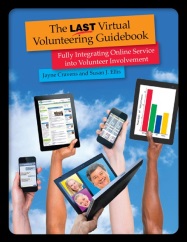 The Last
Virtual Volunteering Guidebook
The Last
Virtual Volunteering Guidebook
available for
purchase as a paperback & an ebook
Published January 2014, there is no
more detailed resource on using the Internet to
support and engage online volunteers, from using
the Internet to screen candidates to providing
appropriate support to virtual teams and
absolutely everything in between. This book
represents more than 20 years of research and
experience from many different sources and is
written in a way as to timeless - no matter how
technologies evolve and social media fads come and
go, this book will, I hope, remain an essential
tool for mission-based/caused-based programs.
A resource from August 1997 provides a fascinating insight into the debates about what community online may or may not be when the Internet was becoming mainstream: Net Surfers Don't Ride Alone: Virtual Communities as Communities by Barry Wellman and Milena Guilia of the Department of Sociology and Centre for Urban Community Studies, University of Toronto. The references list alone is worth review to show just how much hasn't changed in more than 20 years.
You might also want to see an earlier version of
the page you are reading now, to see how my advice
for communicating online has changed. You can do
that by going to the Wayback
Machine / archive.org, and looking for this
URL: http://www.coyotecommunications.com/culture/culture.shtml.
The biggest different in my earlier advice versus
now? Before I emphasized learning about different
styles of text-based communications; now, I think
it's much more important to focus on building
trust and credibility.
Return to my volunteer-related
resources
 my home page my consulting services
& my workshops &
presentations my credentials & expertise Affirmation that this web site is
created & managed by a human. My book: The Last Virtual Volunteering
Guidebook contact me or see my schedule Free Resources: Community Outreach, With & Without
Tech Free Resources: Engaging & Supporting
Volunteers Free Resources: Technology Tips for Non-Techies Free Resources: Nonprofit, NGO & other
mission-based management resources Free Resources: Web Development, Maintenance,
Marketing for non-Web designers Free Resources: Corporate philanthropy / social
responsibility programs Free Resources: For people & groups that want
to volunteer linking to or from my web site The Coyote Helps Foundation me on social media (follow
me, like me, put me in a circle, subscribe to my newsletter)
my home page my consulting services
& my workshops &
presentations my credentials & expertise Affirmation that this web site is
created & managed by a human. My book: The Last Virtual Volunteering
Guidebook contact me or see my schedule Free Resources: Community Outreach, With & Without
Tech Free Resources: Engaging & Supporting
Volunteers Free Resources: Technology Tips for Non-Techies Free Resources: Nonprofit, NGO & other
mission-based management resources Free Resources: Web Development, Maintenance,
Marketing for non-Web designers Free Resources: Corporate philanthropy / social
responsibility programs Free Resources: For people & groups that want
to volunteer linking to or from my web site The Coyote Helps Foundation me on social media (follow
me, like me, put me in a circle, subscribe to my newsletter) how to support my work
To know when I have developed a new
resource related to the above subjects, found a great
resource by someone else, published
a
new blog, uploaded a new
video,
or to when & where I'm training or presenting, use any
of the following social media apps to follow me on any of
these social media platforms:






Disclaimer: No guarantee of accuracy or
suitability is made by the poster/distributor of the materials
on this web site.
The information provided on this website is for general
informational purposes only and should not be considered legal
advice.
I am not a lawyer. I am not a legal professional. Do any
information on this site as legal counsel.
I am not responsible for any losses, damages, or liabilities
that may result from the use of this website or reliance on its
content.
Your use of this website and its information is at your own
discretion and risk.
This material is provided as is, with no expressed or implied
warranty or liability.
See my web site's privacy policy.
Permission is granted to copy, present and/or distribute a limited amount of material from my web site without charge if the information is kept intact and without alteration, and is credited to:

Otherwise, please contact me for permission to reprint, present or distribute these materials (for instance, in a class or book or online event for which you intend to charge).
The art work and material on this site was created and is copyrighted 1996-2026