What some nonprofits ask for in job candidates is ridiculous.

a simplistic drawing of a wizard

Within one week, I saw three different job announcements at three different mid-size or large nonprofits that, altogether, were what I did part-time at a small nonprofit for the last three years. And much of the activities in each of these roles are, altogether, what I have done at nonprofits for the last thirty years.

What each job listed for qualifications was so specific that the organizations are going to end up excluding MANY qualified people – and, probably, the best person for the job. Despite my extensive professional background, despite being expertly qualified for some positions, I don’t even bother applying because so many people don’t see a journalism degree as something desirable now.

When your small or medium-sized nonprofit is looking for someone to be a videographer or photographer, who you are going to pay a salary FAR below the market rate, what you need from job candidates is work portfolios, not a degree in videography or photography. Same for a web designer or a graphic designer or a communications manager and many other positions. And for education, what you may need most is graduation from a recent certificate program, not a full-fledged BA. You need people who can do the job, and since you cannot afford to pay people with the training and experience you are demanding, you need to adjust your expectations.

There’s a better way to attract and screen candidates for roles where the person will produce communications pieces – and will do the job you need done:

(1) Ask applicants to note in their résumés or applications where (in what professional and volunteer positions) they used the tools or produced the projects or demonstrated the skills you are asking for. If your job involves setting up press conferences, or designing web sites, or managing web sites, or designing brochures, or distributing brochures, etc., ask applicants to note in their résumés or applications where they have experience doing that.

(2) Note that you will be asking later for online portfolios from the top 10 candidates, what you will want in those portfolios, and approximately how many weeks you will contact the top 10 candidates to ask for those portfolios. Note how many people you will choose to interview from those top 10 candidates and approximately when those interviews will take place. If someone doesn’t already have the material for a portfolio, they aren’t going to apply – and if they do, they now know they need to make sure their portfolio is full of fantastic examples of their work.

And if you are going to demand that the person use certain specific software – Adobe Photoshop, Lightroom, Premiere Pro, After Effects, Illustrator, InDesign, Final Cut Pro, etc. – then you had better say what YOU are going to provide the selected candidate. What kind of laptop or desk top are you going to provide? Running what software? What kind of camera are you going to provide? Do you have a quiet room for creatives to create and edit? Are you committed to web accessibility and will give your web designer the tools needed to make that happen?

Be flexible in asking for a degree. I know amazing photographers with English degrees. I know very talented videographers with music degrees. I know kick-ass web designers with philosophy degrees.

And, finally: what you see as an entry-level job may be, particularly for seasoned professional in their 50s or 60s, a way to work for a few more years, work at a pace that is better suited to their life now than the senior and executive positions they held in the past, and apply a vast amount of skills and experience that your organization may be in much more need of than you might think. If you are thinking, “Oh, but what about health problems they might have?”, then also consider that it’s likely that candidates in their 50s or 60s aren’t starting families in the next few years, aren’t going to quit to pursue other, better job opportunities, and aren’t going to move across country to get married. And they are no more likely to have home-care obligations than a 30 something.

If you have benefited from this blog, my other blogs, or other parts of my web site and would like to support the time that went into researching information, developing material, preparing articles, updating pages, etc. (I receive no funding for this work), here is how you can help

The campaign against US nonprofits has been a long time coming. The worst of it is starting. Are you ready?

a primitive figure, like a petroglyph, shots through a megaphone

Upon the election of Donald Trump to a second presidency, many nonprofits became wary about how they talk about their work, even their mission statement. Even before the election, many nonprofits rushed to remove any mention of the phrase diversity, equity and inclusion or DEI, or ANY of those words on their own, from their web sites. Now, as the Trump administration threatens to revoke tax-exempt status from nonprofits supporting racial justice efforts, it’s made it further difficult for many nonprofits to communicate at all about their work. This article from the Chronicle of Philanthropy focuses on specific nonprofits who are having to significantly alter their messaging – or put a pause on public communications altogether (note that you must register on the site to read it, but registraiton is free).

Make no mistake: in addition to trying to purge the nonprofit world of work regarding diversity, equity, inclusion, racial justice, economic justice and climate change, they are focusing on the use of the word empathy, and any work regarding such.

This is an issue I’ve been researching, talking about and training about long before the current presidency. Because this campaign against nonprofits has been a long time coming.

I first wrote about the political right’s desire to undermine the credibility and support for nonprofit organizations in 2011, in my blog Could your organization be deceived by GOTCHA media?, where I showed examples of how any cause can become politicized, and any organization can become a political target. My favorite example of this is the successful and horrifying elimination of the wonderful Association of Community Organizations for Reform Now (ACORN), per right-wing misinformation via doctored videos.

I wrote about it again in Growing misconceptions about the role of nonprofits in the USA in 2018. I wrote about it AGAIN in Your nonprofit WILL be targeted with misinformation; prepare now at the start of 2025. And when I watched a nonprofit consultant on an online community advise nonprofits to not just soften their language but to bend the knee to the current administration, I wrote a strategy for myself, in my own work, and it became Your Nonprofit CAN Resist. Here’s how.

I hope your nonprofit won’t back off of its commitment to diversity, equity and inclusion. I hope your nonprofit won’t alter its mission statement. I do hope your nonprofit will:

  • Talk to your board of directors, staff and lead volunteers regularly, repeatedly, about why your nonprofit exists, why it does what it does, and why it has the values or commitments it does. Make sure they know how to talk about all of that from a place of confidence.

If this hasn’t been on a staff agenda or a board meeting agenda yet, then get it on there ASAP. If you had a meeting about it last year, you’re overdue to have one this year. Get busy.

Also see

Nonprofits: be honest with yourself, your staff & the public about how the November 2024 elections may affect you.

Governments cracking down on nonprofits & NGOs

Why I’m not outraged at the IRS from 2013.

Told ya. & I’m still telling you.

An old subreddit revived after seven years, now a place to discuss volunteerism.

After seven years of no activity, the subreddit r/Volunteerism, an online discussion group on Reddit, is back, but with a new purpose, one that makes it starkly different than other subreddits: r/Volunteerism is not a subreddit for recruiting volunteers. It is also not a subreddit to ask “Where can I volunteer.” There are PLENTY of places to post those questions and pleas on Reddit. There are at least 25 different subreddits that exists so that people can ask for volunteers or ask where to volunteer.

Instead, r/Volunteerism is a place to discuss volunteerism philosophies, ethics &, debates, discuss support for volunteers & all aspects of volunteer engagement/management.

Want to recommend your book or blog on volunteer management? Go for it! Want to promote volunteerism – as in “I think volunteerism is necessary for a prosperous society”? Yes. Want to criticize volunteerism, as in “I think volunteerism is a scam and exists primarily so governments and corporations don’t have to pay people for necessary work and here’s why I think that…”? Yes. Testimonials regarding volunteer experience are also welcomed on r/Volunteerism, but not for the primary purpose of recruiting volunteers for one organization.

NO RECRUITING VOLUNTEERS &

NO “WHERE DO I FIND VOLUNTEERING”.

Reddit4Good is a list I made more than 10 years ago and have updated regularly, of subreddits focused on some aspect of volunteerism, community service, philanthropy or doing good for a cause. It includes a list of places on reddit that allow you to recruit volunteers or to ask “Where can I volunteer?” As you will see when you look at it, there are PLENTY of places to on Reddit to recruit volunteers or ask where to find volunteering.

But there is – or was – no where on Reddit that has a focus like r/Volunteerism. And there needs to be.

You may recall that, for many years, I moderated another subreddit, r/volunteer, and that I rebuilt that subreddit over more than a decade into one of the most popular online communities on Reddit. I noted in this blog all of the effort I undertook to turn the community into something of value, particularly for young people who wanted to volunteer and, no matter how many volunteer matching platforms and apps get launched, still need a great deal of guidance about volunteering. I think that via that online community I’ve finally gotten through in a big way to lots more people regarding why trying to be a volunteer can be so hard (because most organizations have zero volunteer management training, don’t have a person dedicated to volunteer engagement, and can’t get funding for such because foundations and corporations refuse to fund “overhead”). But, sadly, a small, angry, vocal group of new members on that subreddit wanted the community to have minimal rules and minimal rules enforcement – never mind that it was that strict moderation that vastly improved the quality of the content over the years and made the subreddit so popular. I wrote why I decided to walk away as moderator from that subreddit without a fight. And I have no regrets that I quit a project that I had made so, so popular.

But I am still on Reddit. Reddit is MUCH more than one community. After having left the other subreddit for about two months, I went back to have a look at how things were going. And it was so sad: the same “where do I volunteer” posts over and over and over. Unvetted organizations with questionable credentials recruiting international “volunteers.” And worst of all: no more posts or debates about volunteerism ethics, voluntourism ethics, volunteerism trends, volunteer management policies and tools, safety, and on and on. It’s now a subreddit just like the more than 20 others that are focused somehow on volunteering – nothing special about it all, and very little of value.

Well, it’s now just like all those other subreddits except one: a silent group called r/Volunteerism. I had put this subreddit on an early version of Reddit4Good, and had described it as an “anything goes” subreddit, just like most other volunteerism-related groups. And then I didn’t look at it for years. When I did, as 2025 ended, I realized that it hadn’t had a new post in seven years and that it didn’t have a moderator listed. After a week of thinking about it, I followed the steps to claim the subreddit and, voilá, the group is mine. Well, moderation is mine. It belongs to Reddit. But I claimed it for one specific purpose: to restore a place on Reddit to discuss volunteerism beyond the FAQs.

Another reason I wanted there to be a place to discuss volunteerism, not just “Where do I volunteer?”: I have been hired three times as a consultant, twice with a mega large, well known social media company, because of my participation on Reddit, specifically because of how I moderated and facilitated r/volunteer. Not going to lie: I would love for it to happen again.

And so, all of you volunteer management researchers and consultants out there, all you leaders of volunteer management associations, all you program managers at the volunteerism-promoting organizations like Points of Light and the Corporation for National Service, here is your chance at redemption. You ignored r/volunteer, probably the largest community focused on volunteering, for years, and now I’m not sure your posts would be welcomed there, given its new focus. But you could post your press releases and event announcements and conference results to r/Volunteerism. Not much of an audience there now, but give me time… I’m awesome at growing Reddit audiences.

FYI, I also moderate other subreddits (r/communityservice, r/inclusion, r/philanthropy, r/OregonVolunteers, r/Tech4Causes, etc.). And participate in far more.

Also see:

Design Checklist: What to Review Before Publishing a Communications Product

A drawing meant to look like a petroglyph. It's of a person carving petroglyphs.

Nonprofits produce communications products, online and in print, from web pages to social media to brochures. Whether that product is designed by a professional designer or is designed by someone who has never had a design class, there are certain qualities those products MUST have. And while there are a plethora of online resources that provide excellent guidance on accessibility and usability for online products, like web pages and apps, there is a lack of guidance for how to make print products and graphics associated with social media relevant / necessary, complete, informative, legible for a majority of viewers / readers and understandable for a majority of the target audience.

This new page on my web site provides simple, easy-to-understand guidance for both designers and those who have the final say on something being published.

Design Checklist: What to Review Before Publishing a Communications Product.

And before I get the comment – yes, it’s pretty clear from the simple, almost primitive design of my web site that I’m not a professional designer. But when you work in communications for nonprofits, you often have to design flyers, posters, brochures, web sites, etc. My designs are plain and blocky. My designs won’t win any design awards. However, my designs adhere to all of the aforementioned suggested qualities, and that means they work: I am amazing at recruiting volunteers, at getting attendance to an event, at getting participation in a program, at getting traffic on a web site, and on and on.

Even if you are NOT a professional designer, you know what your nonprofit needs. You know your audience, which likely includes seniors and people over 40 who do not like to be called seniors but also can’t read 9 point fonts.  

If you have benefited from this resource, my other blogs, or other parts of my web site and would like to support the time that went into researching information, developing material, preparing articles, updating pages, etc. (I receive no funding for this work), here is how you can help

How to get a variety of staff to create roles for volunteers.

graphic representing volunteers at work

It’s controversial to say, but here it is: I believe that creating volunteering roles is NOT the primary responsibility of the manager of volunteers and that most volunteers should not be working just the manager of volunteers.

And working from this premise, it’s impossible for the manager of volunteers to create most of the roles for volunteers; it takes program staff and even administration staff, a mix of employees and leadership volunteers, to be the primary generators of volunteer roles.

Consider a community theater that produces live performances: a manager of volunteers at such a nonprofit wouldn’t recruit volunteers to help build sets without first talking to the person in charge of set building and that person defining what volunteers will do. Such a manager at a nonprofit animal shelter wouldn’t recruit volunteers to show up to walk dogs without first talking to the shelter manager and working out what training needs to happen, as well as a schedule.

And if these other staff members, whether employees or volunteers, don’t want to involve volunteers, the work of the manager of volunteers is, quite frankly, doomed to failure.

Now, here’s the kicker: how do you encourage, or even require, staff to involve volunteers in their work?

In more than 25 years of working with volunteers and researching volunteerism, I’ve seen what works and what doesn’t. I finally decided to write it all down – and now I have updated the resource on my web site about how to create volunteering roles to include advice on what it takes to get staff to involve volunteers in their work. Have a look and, if you have more advice, offer it in the comments on this blog or email me directly.

If you have benefited from this blog, my other blogs, or other parts of my web site and would like to support the time that went into researching information, developing material, preparing articles, updating pages, etc. (I receive no funding for this work), here is how you can help

America Gives, a nationwide initiative designed to make 2026 the largest year of volunteerism in U.S. history

America250, the official nonpartisan organization established by Congress to lead the USA’s 250th anniversary commemoration, launched America Gives, a nationwide initiative designed to make 2026 the largest year of volunteerism in U.S. history.

America Gives challenges businesses, nonprofits, schools, youth groups, faith-based networks, and organizations of all kinds to commit to increasing their volunteer efforts and measurable impact.

The initiative aims to build a movement of sustained impact — helping nonprofits expand their volunteer bases and inspiring individuals to continue giving back long after the fireworks fade.

America250’s National Co-Chairs are former Presidents Barack Obama and George W. Bush.

Americans can take the Year of Service pledge and log their volunteer hours at America250.org/America-Gives. A live national counter on the site will track participation in real time, showcasing the collective hours of service across all 50 states, 5 territories, and Washington, D.C.

Participants can easily record their hours by entering their volunteer activity details directly into the America Gives portal. They can also upload stories and photos to inspire others and explore opportunities to get involved.

Americans can also visit the America250 website at America250.org/America-Gives to find service opportunities near them and based on their interests. America250’s National Resource Partner, Points of Light, will help join interested volunteers with the right organization. 

For ideas for volunteering beyond volunteer matching databases, see this resource, which offers advice regarding volunteering with seniors, volunteering to support wildlife or natural spaces, how to create your own leadership volunteering activities and more.

2026 is also the 2026 the International Year of Volunteers for Sustainable Development. I’ve created a IYV2026 resource on my site that notes the origins of the year, highlights the accomplishments and resources of the first International Year of Volunteers in 2001, and links to the growing number of official resources. I hope it can be used both to help organizations prepare for IYV2026 and to compare resources now and then, to see how far we’ve come and how much more we need to do.

January 21, 2026 edit: turns out that there is ANOTHER initiative as well:  well-financed, privately funded initiative called the “Be The People” campaign. It’s funded by a mix of 50 philanthropic foundations and individual donors. According to this article on the PBS News site, “Be The People,” will not incorporate as a new nonprofit, but act more like a banner for groups to organize under and use to connect to resources.

30 Years on the Web

my company logo of a coyote howling at the moon

30 years ago yesterday, I launched my own web site online, a place to publish some of the work I was regularly posting to the soc.org.nonprofit USENET newsgroup, like Basic Customer Database Principles and Overview of Databases.

I created those database tips because so many nonprofit staff were being asked to manage data about volunteers, donors, event attendees and clients, but they had zero background in data management, and were regularly asking for help on that online community. My data management background came from hands-on experiences, mostly at nonprofit theaters, which live and die by data about event attendees and donors – and we used index cards before computers. I kept developing new web pages on other tech-related subjects to offer advice in plain language, because I felt like software developers and tech bros were doing a lousy job of doing so. I wanted to present tips for using all this emerging computer and Internet technology in human language so it could be understood by anyone, not just IT folks, and to show what it could do in language that showed it really was a great tool, not just something shiny.

I called my web site Coyote Communications. I wrote about why I called it that here, and what my driving philosophy was in creating the web site. That page also offers guidance on how to see that very first web site.

Merely having a web site of my own helped in my landing a few jobs in the 1990s, though I abandoned my web design business after my first client – I knew I was no web designer, although I quickly turned out to be quite a good manager of such, which is also a very important skill to have.

It was 1996, the start of what turned out to be a year of tremendous loss and change for me. I was really excited about launching my own site and, having been online for a couple of years and having a really positive experience from such, I was really optimistic about what the Internet could mean for humanity. I was downright perky. As I ended the year in a new home in Austin, Texas, having completely rebooted my life, I was down about personal things but still optimistic professionally, mostly because I was starting a new job that would allow me to do the oh-so-radical thing of work from home, a job I’d gotten because of my online work up to that date: I began designing the program I would direct for four years, the Virtual Volunteering Project, an initiative that eventually led me to a job, and a career, with the United Nations and a long time association with TechSoup.

But that’s getting ahead of myself. Back to Austin at the end of 1996: years passed, and my web site evolved as I evolved professionally. I never got rid of that focus on tech tips for the non-tech person at nonprofits, but over the years it expanded to resources for Community Outreach, With & Without Tech, resources for Community Engagement, Volunteering & Volunteerism, resources for people Working in International Development, particularly regarding communications, and travel resources for women, especially women motorcycle riders.

Lots of observations as I think about this anniversary:

  • People were nicer online in the 1990s. No question.
  • Web sites were easier to use 20 years ago.
  • It is so jarring to talk with people younger than my web site.
  • I could not survive without the Internet Wayback Machine.
  • I thought that accessibility in web site design would be a widespread priority now. I remain stunned that web site accessibility is still not the industry standard, and that so many web designers, and those that employ them, have either never heard of it or don’t think it’s important.
  • I thought the US Congress would have designed much better laws to protect the data of citizens and other residents, as well as visitors.
  • Most of the ideas I hear from tech bros regarding their new tech tools aren’t new ideas.
  • I have close friends and professional colleagues now that I first met online. Those type of connections don’t happen nearly as much now as they did in the 1990s and 2000s. I met so many of them on YahooGroups. I so miss YahooGroups.
  • I think those of us who worked in environments without computers and the Internet are better at using tech tools than so-called “digital natives.” My generation knows that we always have to be ready to adapt to change, and knows that most of the time we’re on our own to figure out how to use something – and how to best leverage that tool in our work.
  • AI slop is insidious and is ruining the Internet.
  • The algorithms that are supposedly putting information in front of us based on our unique preferences are making it harder to find the information I’m actually looking for. Search engines worked far better even 15 years ago than they do now.
  • The algorithms that are supposedly putting information in front of us based on our unique preferences are driving misinformation and a startling, horrific extreme right wing agenda. I regularly get things in my social media newsfeeds that I’m not only not interested in, they go against everything I believe at my core – and what I believe at my core is no secret online.
  • We all need to spend less time looking at computer and phone screens. More time looking at movie screens is acceptable.

I hope my web site is still valuable to someone out there. And I hope my 2026 goes far better than my 1996.

Also see:

What does Reddit AI say about YOU?

Here’s what it says about me (It’s accurate – but it’s also based on my actual words, not what it thinks I have said):

Reddit name: coyotebroad. u/jcravens42. Joined 12 years ago. 69/.9K karma. Moderator. Overview: Posts focus on volunteer opportunities and philanthropy. Co,ments offer constructive criticism and advice in relevant subreddits. No NSFW or hateful content detected.

Hope you are ending 2025 well, and I wish you a 2026 of prosperity and your best hopes fulfilled.

And here is my list of Reddit4Good, a list of subreddits somehow focused on philanthropy, volunteering, noprofits and “doing good.”

How to Keep Immigrant Volunteers at Your Nonprofit or Community Program Safe From ICE

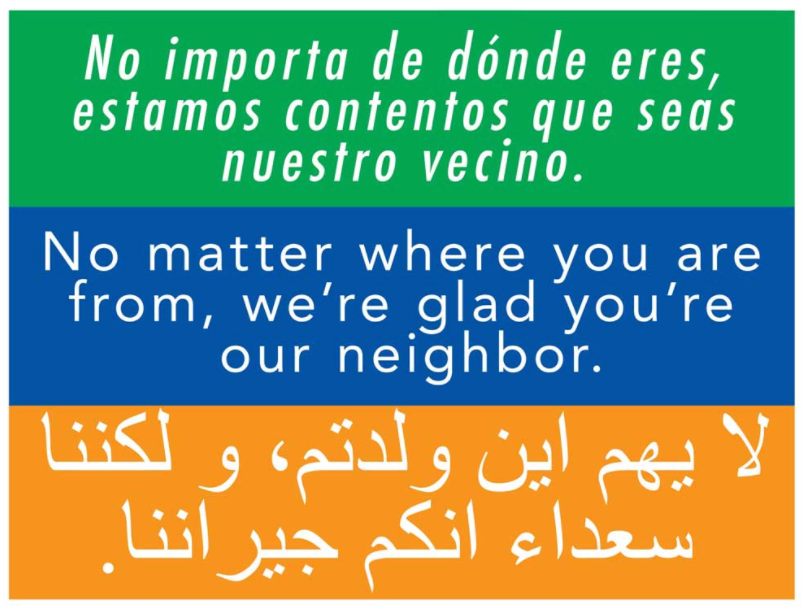
In three languages, the phrase "No matter where you are from, we're glad you're our neighbors."

Disclaimer: this is not legal advice. I am not a lawyer. Any activity incurs risk. The author (me) assumes no responsibility for the use of information contained within this document.

I don’t usually blog twice in a week, but this couldn’t wait:

In the USA, it is imperative that you keep immigrant volunteers, clients and employees safe from Immigration and Customs Enforcement (ICE), which has been documented frequently abducting people, many of whom have no criminal records and many of whom are in the USA legally.

Among the things you can do to help volunteers specifically:

(1) Be aware that volunteers who are immigrants may need to cancel their volunteering shift within minutes of it starting, in order to stay safe.

(2) Remove names and photos of volunteers who are immigrants from social media and your web site if you think there is any chance whatsoever of the information being used by ICE.

(3) Encourage volunteers who are immigrants to check in with their families frequently, such as every time they leave any location and when they arrive at any location.

(4) Have emergency contact information for all volunteers.

(5) Have sections of your work sites clearly marked as “Staff only” and “This area is closed to the public”, and make sure all staff know which areas these are and the different ways to access them quickly. Anyone – including ICE agents – can legally enter public areas of your business without permission, but not areas marked “private.”

(6) You may want to have a lookout specifically for ICE. For instance, perhaps you have volunteers building a house, or cleaning up a yard. Put up signs that say “Private property” on such outdoor sites and have someone, even two people, whose role is to watch out for ICE and to warn others if they suspect ICE agents approaching.

(7) Train all staff on how to quickly warn everyone on the premises that ICE may be entering the building or worksite (whistles are very effective) and how to direct people to private areas.

(8) Train your staff to NOT TALK to ICE agents. A worker can say, “I can’t give you permission to enter this private area. You must speak with my supervisor.” Practice – just like a fire drill.

(9) Immigration agents can enter a private area ONLY IF they have a judicial warrant. A judicial warrant must be signed by a judge and say “U.S. District Court” or a State Court at the top. Without a judicial warrant, ICE agents need YOUR permission to enter private areas of your business. If ICE agents try to enter a private area, you should say: “This is a private area. You cannot enter without a judicial warrant signed by a judge. Do you have a judicial warrant?” If ICE agents tell you that they have a judicial warrant, ask for a copy and read it. Sometimes, ICE agents try to use an administrative warrant to enter. But an administrative warrant does NOT allow agents to enter private areas without your permission. Administrative warrants are not from a court. They say “Department of Homeland Security” and are on Forms I-200 or I-205. (5) Connect with immigration response networks in your area. Look at their social media and web site and if they have a workshop on dealing with ICE, go to it.

Much of this advice was adapted from What to Do If Immigration Comes to Your Workplace from the National Immigration Law Center and the National Employment Law Project.  

Here are more of my resources on related topics:

Want a list of all the companies selling community service hours? I have it.

graphic representing volunteers at work

Are you an officer of a US court, a law enforcement officer, a police officer, a probation officer, or any official charged with overseeing people who have been assigned community service by a court, and part of your role is to verify their community service hours? Then you need to be aware that there are companies that, for a fee, which they call a “donation”, will give a person assigned community service by a court a letter claiming they did those volunteering hours.

These companies are registered nonprofits, and their web sites are carefully worded to imply that they help connect people assigned with community service, or who need volunteering hours done FAST, with online volunteering opportunities, also known as virtual volunteering. But these nonprofits’ web sites list no board of directors, list no staff members, and list no activities being undertaken by that nonprofit. They will say things like “our programs are developed and reviewed by a team of trusted professionals – including doctors, clinicians, professors, licensed psychotherapists, clinical psychologists, and certified behavioral health coaches.” But then never name even one of these experts on their “team.” And as you dig deeper, you discover that the “virtual volunteering” isn’t volunteering at all: it’s writing essays to say how you felt about watching a video (which you don’t really have to watch) or reading someone else’s essay. Or developing a “personal growth” plan. One company says its volunteering is “self-guided, growth-oriented activities focused on personal development and rehabilitation” and the process is like “group therapy.” And, of course, they say that you can volunteer for them by posting about their wonderful program to other social media platforms, Craigslist, etc., bringing them more paying customers.

And if you dig even deeper, you discover that the nonprofit will give a person a letter saying they volunteered for a certain number of hours, and they will base those number of hours on how much the volunteer “fundraises” for the nonprofit. “you can begin your community service now and pay later with a $20 registration plus an access fee of $1 per work-hour (based on the time you complete.)” So for 300 hours, a customer pays $320. They claim this is to cover fees to administer the program – yet, where’s the list of staff they pay? Where’s the financial annual report saying what their fees are?

Virtual volunteering is real. In fact, I have researched, documented and engaged the practice since the 1990s. I wrote a book – many call it THE book – on virtual volunteering. I have a wiki that details what virtual volunteering actually looks like – and it’s not writing personal growth plans or watching videos and then reflecting on how they make the viewer feel. Many thousands of nonprofits and NGOs and government agencies have been involving volunteers to develop web pages, translate texts, transcribe videos, transcribe historical documents, design graphics, add keywords to photos, and on and on – LEGITIMATE online volunteering tasks.

That’s one of the reasons I’m so angry at these companies that associate their selling of community service with virtual volunteering. It’s a subject I care about deeply, and I hate to see it maligned. And some courts now no longer accept virtual volunteering at all for community service because of these unethical nonprofits.

I have a list of these companies that are engaged in this practice of selling letters saying someone has completed community service. I won’t post the list online because I know it will be used by people desperate to get community service done – it will turn out to be wonderfully promotional for these companies. But I will give the list to any person who contacts me from an email address that is associated with a court or law enforcement agency. I’ll be looking for .gov at the end of email requests and I’ll be double checking names at the agencies web sites to make sure you really work there. But once verified, I’ll be happy to send you my list, which I update frequently. My hope is that you will use this list to tell those you are working with, “No, you may not use these companies for your community service hours.” And that over time, they will be driven out of business. Or even better, that your state attorney general will investigate them, as other states have done, and shut them down.

And if you want to recommend LEGITIMATE virtual volunteering to court-ordered folks, here’s a list of credible organizations, like the Library of Congress, where such can be found.

Here are all of the blogs I’ve written to date on this subject. You will see accounts there of courts shutting down nonprofits that engage in this practice, and some courts refusing to accept virtual volunteering at all because of the practice of selling letters that say someone did community service hours.

Please note that I have had some great experiences with community service folks as volunteers – most that I’ve worked with have ended up volunteering long past their required hours, because they enjoyed the experience. I don’t want to further punish them – but I do want them to not get ripped off, and to not further engage in unethical, and possibly illegal behavior.

Contact me here.