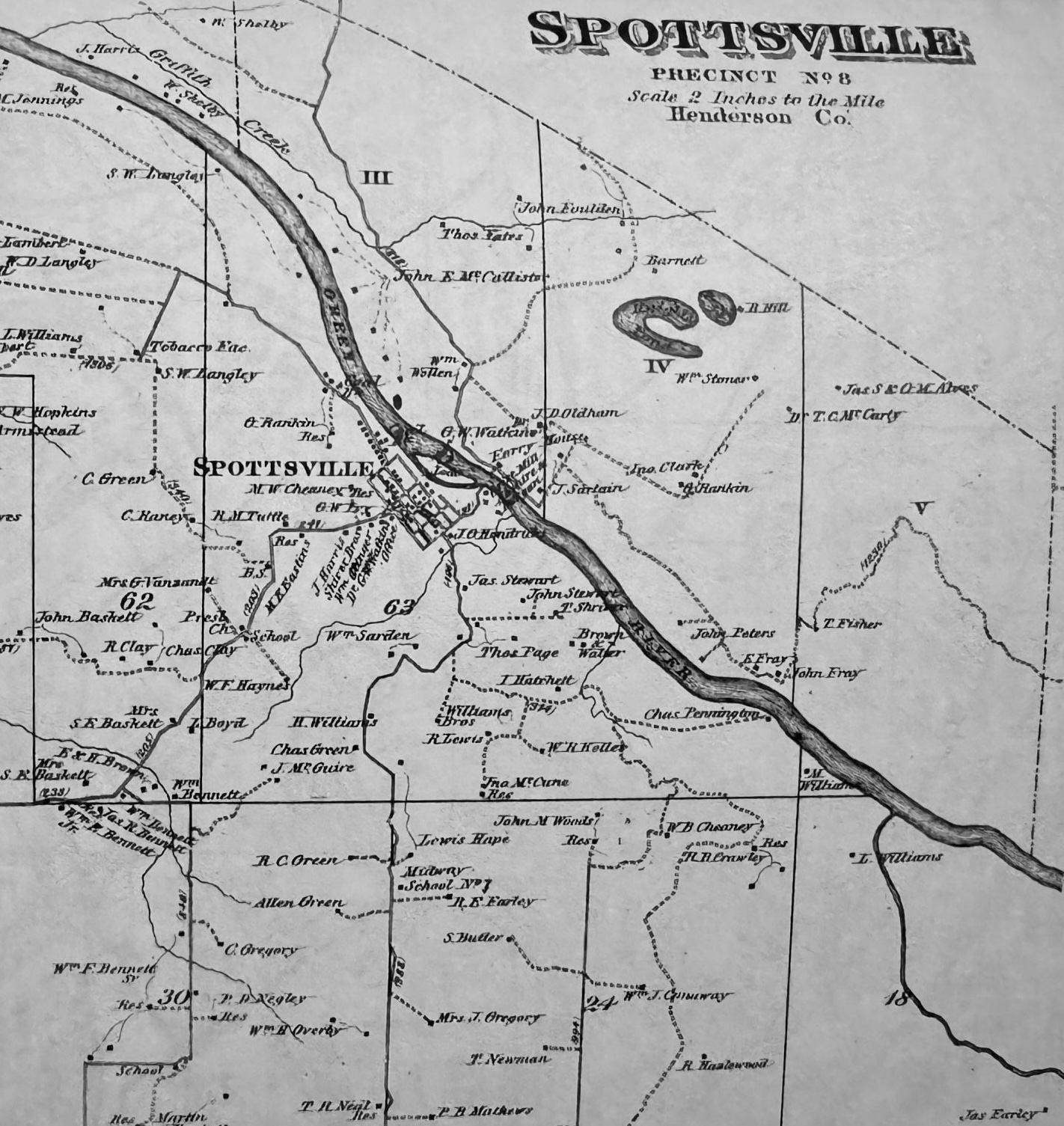
Spottsville, Kentucky, a barely-a-town in Henderson County, is the first place I ever lived, and I spent every Friday night and Saturday there for the next 10 years after I moved away, to the "big city" of Henderson, when I was almost three-years-old - and then various weekends well into my 20s. Spottsville may be tiny, but it was a huge part of my life in the late 1960s and all through the 1970s.
As of the 2020 census, Spottsville had a
population of just 274 people. It used to be bigger, though I'm
not sure it ever had more than 600 residents.
It bothers me that there is not a comprehensive
history and profile of Spottsville, Kentucky online, not even on
Wikipedia, certainly not one that comes up in an Internet
search, so I decided to make one on my own web site.
Spottsville is about four miles from the
confluence of the Green and Ohio Rivers. The area has been
inhabited by various people for thousands of years. Since
Spottsville is near the Angel Mounds outside of Newburgh,
Indiana, across from the area on the Ohio and Green Rivers, and
since there are records of mounds being destroyed in Henderson
in the 1800s and 1900s, it can be concluded that people of the
widespread Mississippian culture that developed around AD 900
were also in the Spottsville area. The mound builders of the
Middle Mississippian culture lived in what became southwestern
Indiana around AD 1100 and remained there until AD 1450, so
people of that same culture were probably in Spottsville too.
One hundred years later, the groups in the Spottsville area were
called the Kashinampo, the Quizqui, and the Chiska Cherokee by
European colonizers: the area that is now Spottsville was
visited by the Spanish explorer Hernando de Soto in 1541, and
his army was attacked near the Ohio River by local tribal
members.
Long after that, the Cherokee East, Shawnee, Osage
and Miami peoples were in the area, often at the same time.
As I child, my brother regularly found arrowheads
on the land my grandparents owned in Spottsville, which ran
along an unnamed creek that ran behind their house, about a mile
from the Green River. For some reason, those artifacts weren't
kept. Had they been, of course I would have turned them over to
tribal representatives. The area remains largely unexcavated for
First People's artifacts.
Spottsville, Kentucky was named for Major Samuel
Spotts, who is said to have shot the first gun at the Battle of
New Orleans on January 8, 1815, which was fought between the
British Army and the United States Army.
In 1833, before the locks were constructed at the falls, it was called Knight’s Falls, and the only buildings on the banks were rude shacks which were owned and occupied by men who were engaged in quarrying rock. Another name it went by was “Shanty”, derived from the fact that the quarrymen had built a number of shacks in which to live while they worked tock. It was afterwards known as “The Locks”.
As early as 1829, Major Spotts owned most of the
land lying on the Green River near the Ohio. Later, in 1833,
Robert Scott, Major Spott’s brother-in-law, sank a shaft for
Major Spotts. The object was to float coal to New Orleans, but
it didn't work out and little coal reached that market. Spots
spent several summers prior to his death with his
brother-in-law, in what is now called Spottsville. Spotts was
appointed to a federal position in New Orleans, but during the
summer of 1833, died of cholera. He was buried somewhere in the
New Orleans area, and he is memorialized at the Chalmette
National Cemetery in Chalmette, St. Bernard Parish, Louisiana.
Spotts' wife is buried in a cemetery in Spottsville, but I don't
know her name nor if her grave is marked.
In 1850, the place took on the name of
“Spottsville”. Major Spotts’ children, Harry and Jim, their
wives, Mrs. Lydia McBride and Miss Lydia Scott, gave it that
name in honor of their famous father / father-in-law.
Spottsville was first established as a precinct
and voting place in 1860.
Most of aforementioned information in this section
comes from a web site called the History
of Spottsville.
Another web site that doesn't exist anymore (see bottom of this page) says that a number of Spottsville chimneys toppled during the earthquake of October 31, 1895.
Spottsville built up its coal interests and in
time became a somewhat flourishing town. From 1904 to 1911 as
many as 116 men of the Green River Coal Company mined coal,
including underground shafts, in Spottsville. The Pittsburgh
Coal Company operated a 75-man coal camp in Spottsville from
1911 to 1924. And my grandfather worked for the Wolf Hills Coal
Company, owned by Leo King, Sr.
and Gus Johns (and I can find no record of this company, or Gus
Johns), prior to World War II.
"Downtown" Spottsville sits on the banks of the
Green River. You can see the Green River Lock & Dam from US
60 Spottsville bridge as it crosses the river. You can also the
Spottsville Railroad CSX Swing Bridge, a through truss swing
bridge, also crossing the Green River. The swing bridge dates
from the 1880s in its original foundation. The current major
metal span structure dates back to its 1926 reconstruction. The
railroad line that crosses it runs from Louisville, Kentucky to
Henderson. According
to Bridge Hunter the bridge was built by the Keystone
Bridge Co of Pittsburg, Pennsylvania. The bridge turns in the
middle, creating two big gaps for barges to come through on the
river, then turns back to restore the track lines for trains.
I've never seen it turn. I've only seen it after
it turns.
The earliest bridges in Spottsville that crossed
the Green River, for both the highway and the railroad, were
marked by collapse and the loss of lives, including a 1904 train
wreck.
A payment dispute during the original railroad bridges'
construction prompted the Keystone Bridge Company to place six
men at the bridge in 1889 to prevent its use. The men physically
threatened the railroad men and told them to leave. The Keystone
contingent then swung open the span, started removing the rails
and ties from the upstream end, and began throwing them in the
river. They had stripped it and were headed for the much heavier
downstream end when the overbalanced bridge broke in two and
toppled steel, ties and men into the icy river below. Some men
had jumped in the river and grab railroad ties when they saw the
bridge tipping, about six or seven clung to the middle of the
bridge, and others went down with the bridge. The steamboat
General Dawes had just passed under the bridge and escaped
disaster by only a few yards. The steamboat immediately stopped
and put out lifeboats. The tugboat Corinne and skiffs at
Spottsville also deployed for water rescues. Initial reports
said 20 to 35 men had drowned, but only one body was found,
although other men were injured.
The Keystone company rebuilt the span after
settling the dispute. The bridge opened to traffic March 11,
1889.
The Texas railroad, as that line was first called,
later went bankrupt and was reorganized as the Louisville,
Henderson & St. Louis Railroad in 1896. At 8:38 p.m. on Aug.
8, 1904, it had its worst train wreck in its history when an
eastbound freight train plunged into the river while the
Spottsville swing bridge was open. The locomotive turned a
somersault on the way down and was followed by about ten cars.
It’s unclear how many fatalities there were. Survivors, many of
whom were riding illegally, said two or three Black people had
been riding in boxcars ahead of them and went into the river.
Their bodies were never found. There were also reports of four
white "hobos" who were never found.
The swing bridge was rebuilt in 1926 to carry
heavier traffic.
U.S. 60 had to wait until the end of 1931 to get a
bridge at Spottsville. And that construction project also proved
deadly when the uncompleted span collapsed about 5 p.m. July 8,
1931. The accident dropped four men into the water along with
tons of steel and wood, according to articles in The Gleaner and
the Courier. There was just one survivor.
There's more complete
details about these bridge disasters in this story in the Hendersonian.
I created a series of screen
captures of driving over the US 60 bridge in Spottsville
from Google Streetview before the bridge was replaced in 2022. I
wanted to be able to remember what Spottsville looked like for
most of my life. The bridge was so narrow that it wasn't unusual
for people to have their driver's side mirrors destroyed by
opposing traffic.
Spottsville still has an elementary school, far
outside of "downtown", on US Highway 60. But Spottsville used to
have a high school as well. The first version opened this week
in 1920 and was also the first Henderson County school to bus
students. The school was, according to one description, “midway
between the town of Spottsville and the Henderson Route railroad
station on a high bluff overlooking the Green River. It sees and
can be seen for miles around.” The description The Gleaner gave
is as follows: “The school has a spacious basement, an assembly
room capable of seating from 400 to 500 people” as well as
classrooms and rooms for a library and teachers’ lounge.
Initially, it handled only the grade school classes and the
first two years of high school. In 1931 the school was expanded
so it had nine classrooms, three halls, a music room and the
principal’s office. But the school was destroyed by fire March
9, 1932, when sparks from a flue fell onto the roof. The
school’s enrollment at that time was 298, of which 131 were
attending high school. About 200 were in the school when the
fire began just before 8 a.m. “Residents and students formed a
bucket brigade, but their efforts were unavailing, and the
building was reduced to a heap of ashes.” The separate gymnasium
and the principal’s cottage were saved from the flames.
The new 1932 school cost $22,039. Beloved
Henderson County Judge-Executive Sandy Watkins used to fondly
call the “University of Spottsville.” The high school was used
until mid-1981, when a newer school closer to downtown Henderson
was completed. The building was sold and went through several
owners before it was the victim of arson, according to The
Gleaner of July 29, 1992. It was razed in mid-2003. (all
information about the Spottsville High Schools is from
The Gleaner).
The buildings in Spottsville just before the car
bridge have held various businesses, including a restaurant and
an auto mechanic.
The closest thing Spottsville has to a celebrity being from there is Holloway Smith. He was the second African-American student-athlete admitted to Iowa State (Jack Trice was the first). Here's more about him, a biography I wrote from two resources and some federal documents, noted within the text:
Holloway Smith was born in Spottsville, Kentucky, on November 19, 1896, according to his World War I Draft Registration Card, which completed in Henderson. He was the son of James and Harriett Smith, according to the 1900 U.S. Federal Census. He served in World War I and came to Ames, Iowa as a 29-year-old Army veteran. In the fall of 1926, Smith was one of 3,960 students who reported to campus for classes. During preseason practice, Smith received his first mention in the Iowa State Student newspaper:
Among the outstanding men who are seeking (a starting) assignment are Holloway Smith, the big colored boy...Smith is one of the first colored aspirants to the Iowa State team since the great Jack Trice, and he is showing up as varsity material. Smith is 6 feet 3 inches high and weighs about 219 pounds.
The Iowa State Cyclone says "At 6 feet, 3 inches tall and 219 pounds, Holloway was gargantuan among his teammates. Tackle to tackle, the Iowa State starters that fall weighed an average of 181 pounds. It should be noted that The Student's figures conflict with Iowa State game programs, which list Smith at 195. Even at 195, he would have been a monster on the State Field midway."
The Cyclone says Smith was voted third-team All-Missouri
Valley Conference his senior year.
After graduation, Smith taught at the Marianna School in
Arkansas, though in 1935, he had lived in Louisville,
Kentucky, according to the 1940 U.S. Federal Census. In
1936, African American newspapers proclaimed him the last
Negro football player in the Big Six Conference, made up of
Oklahoma, Missouri, Iowa State, Kansas, Kansas State, and
Nebraska. But by then, he had moved on from his football
playing days, though he did coach high school teams. He was
in the Arkansas school system for several years, as teacher,
then master teacher and finally as principal. He was also a
state supervisor in Arkansas for the National Youth
Association, a New Deal program that provided work,
education and housing for youth from 16-24 during the Great
Depression.
Smith left Arkansas in the 1940s. He served as a temporary
member of the YMCA USO Club on 3rd Street in Pittsburg,
California in 1945, according to the USO-Staff Conference
minutes of June 11, 1945. In later life, Smith operated a
restaurant, Ella's Southern Kitchen Restaurant, in Monterey,
California, before moving to Reno, Nevada in the early
1960s. He died in Reno in 1970 at the age of 73. He is
buried in the Mountain View Cemetery in Reno. In addition to
the Cyclone, information in this biography comes from the Notable
Kentucky African Americans Database.
I fondly remember a diner in "downtown"
Spottsville, right on US 60, that served the best hamburgers
EVER. My paternal grandfather, my papaw, would take me and my
brothers there sometimes and I thought it was the most delicious
meal imaginable. I also cherish my memories at my grandparents
little two-bedroom house, with a gas lamp out front. They had
about three and a half acres of land, maybe more. My
grandparents house and the one next door, which they also owned
and which was the first house I lived in, were brought from the
city of Henderson - my grandfather told me they were moved from
the area that is now between Klutey Park Plaza Drive and US
Highway 41, where the big grain elevators used to be. I think he
said they had to be moved because those grain elevators were to
be built, but I could be misremembering.
Almost half the entire property stayed empty, and
it was a joy to sit on my Papaw's lap on his red tractor as he
mowed. He once hooked up a trailer to the back of the tractor
and took us kids around the land, and we thought it was the most
fun thing EVER. We also had a pony for a while, Debby, in a
corral. My grandparents, then just my grandmother, kept a garden
behind her house. It was so big at first that Papaw tilled it
with the tractor. One time, I remember one of my brothers
driving the tractor, before he had a driver's license, with
Papaw steering an old fashioned till behind it. It was so
dangerous, so inappropriate - so country. My family regularly
had fresh produce from that garden. The Spottsville garden
started to shrink after Papaw died - Mamaw couldn't handle a big
garden on her own anymore. Then my brother and his wife moved in
next door, and my sister-in-law started helping with the garden,
and it got quite big again.
About half of my grandparents land in Spottsville
was empty. My grandfather had dreamed of all of his
grandchildren having homes there someday. In the meantime, he
rented part of the property to trailer owners. At one time,
there were three trailers on the property, all well-kept. Papaw
dug the septic tanks himself. But the trailers never lasted
long, and the last renter abandoned their trailer altogether in
the 1990s. The house next to my grandparents', where I had first
lived as a baby, also fell into disrepair as my grandmother
aged. She eventually sold the land to her great-nephew, who
subdivided the land to sell part of it to, ugh, Dollar General
Store.
The creek behind the house never flooded to any
point that there was a danger to any of the homes, that I
recall, and sometimes the creek dried up completely. I spent so
much time playing at that creek, damning the water or pretending
I was Robin Hood. I believe this is where my brother found a lot
of the Indian arrowheads. Several yards to the East, on someone
else's property, there was a wide space of the creek, which we
called a pond, at the base of a hill - at the top of the hill
was a house that had a full beauty shop in the basement. I
remember that pond froze solid one year, and my brother and I,
and a kid that lived next door, sledded down that hill over and
over, skidding across that ice pond at the end. It was so much
fun and probably dangerous. From what I can see on satellites,
the pond has been either moved or a huge expanse has been built
so that all the water stays there, and doesn't feed the creek
anymore.
I stopped going to Spottsville after my
grandmother moved to town in her 80s, and I have been through it
only twice since she passed away, and both times closed my eyes
when we got near her house, because I cannot stand seeing that
ugly, parasitic Dollar General store there next to what used to
be her house.
I think it would be amazing and glorious if there
was a hike and bike trail from Henderson to the Spottsville
bridge. I think it would lead to a restaurant or food cart
opening at the bridge, and maybe more.
One last thing: there was a web site called spottsville.com
that doesn't exist anymore, except
on archive.org.
my family home page | about me | contact me
The personal opinions expressed on this page are solely those of Ms. Cravens, unless otherwise noted.